Bhutan Builds 108 Chortens in One Day: A Historic Achievement of Faith and Unity
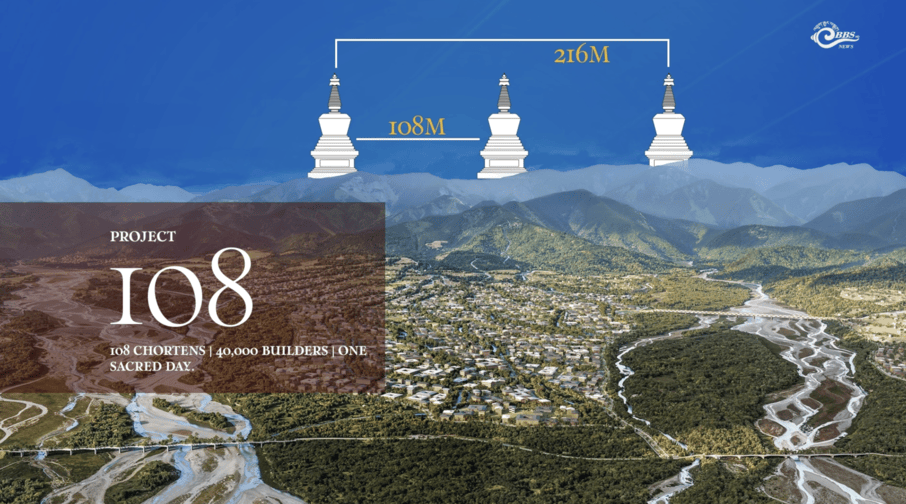
On 1 November 2026, something extraordinary took place in the southern Bhutanese town of Gelephu. Along the banks of the Mau Chhu River, thousands of volunteers came together to raise 108 sacred Buddhist chortens in a single day.
What would ordinarily appear to be an enormous construction undertaking became something much more meaningful: a collective act of faith, devotion and service.
Approximately 40,000 volunteers participated in the coordinated effort. By the end of the day, the external structures of all 108 Jangchub Chortens, each standing 15 metres tall, had been completed.
The achievement was remarkable not simply because of its scale, but because of what it represented. It brought together people from across Bhutan, united by a shared spiritual purpose.
For a country where Buddhism is woven into everyday life, Project 108 was a powerful expression of Bhutan's living spiritual heritage. It also offers visitors a deeper understanding of why Bhutan is often described as one of the world's most distinctive spiritual destinations.
What Happened in Bhutan on 1 November 2026?
The successful raising of 108 Jangchub Chortens marked a major milestone for Gelephu Mindfulness City, a Royal initiative in southern Bhutan.
Conceived under the vision of His Majesty King Jigme Khesar Namgyel Wangchuck, Project 108 brought together spiritual devotion, community participation and an extraordinary level of preparation and coordination.
The 108 chortens were placed along the Mau Chhu River, separated by approximately 108 metres from one another. Together, they form a continuous procession of sacred structures extending over approximately 11.7 kilometres.
Work began in the early hours of 1 November, with trained teams assembling prepared components at 108 separate locations.
By the afternoon, the external structures of all 108 chortens had been raised. Associated Press reported that the assembly took approximately 12 hours and that an estimated 200,000 people gathered for the occasion.
Buddhist masters, monks, devotees, volunteers and visitors joined the observances. Traditional religious instruments sounded, prayers were offered and the occasion was marked by national and religious ceremonies.
The day held additional meaning because it coincided with Lhabab Düchen, an important Buddhist holy day commemorating the Buddha's descent from the heavenly realm, as well as the eighteenth anniversary of His Majesty the King's coronation.
How Did Bhutan Raise 108 Chortens in a Single Day?
Completing such a large undertaking required far more than the work carried out on 1 November.
Preparations had begun months earlier. Sites were identified and cleared, foundations were constructed and building components were prepared for coordinated assembly.
Volunteers were organised into teams, with specific responsibilities across the 108 locations.
The project combined engineering, logistics, skilled craftsmanship and an extensive volunteer effort.
Spiritual Preparations
Alongside the physical preparations, religious practitioners worked on the sacred contents of the chortens.
In Bhutanese Buddhist tradition, a chorten is not simply a structure of stone and other building materials. Its sacred contents and consecration form an essential part of its religious significance.
Monks prepared scriptures, mantras, sacred objects and other offerings intended to be placed within the structures. These preparations involved traditional religious practices and consecration rituals.
The project's religious programme continued beyond 1 November, with additional prayers and consecration activities scheduled through 4 November.
Thousands Working Towards One Purpose
The scale of community participation was one of the most meaningful aspects of Project 108.
Volunteers came from different professions, age groups and communities. Each person contributed according to their role and ability.
Some assisted with preparation and assembly, while others supported the wider organisation and religious observances.
The success of the day demonstrated what careful preparation and a shared purpose can achieve.
Why Is the Number 108 Sacred in Buddhism?
The number 108 holds special significance in many Buddhist traditions, including the Vajrayana Buddhist tradition practised in Bhutan.
Buddhist prayer beads, commonly known as a mala, often contain 108 beads. Practitioners use them to count mantras or prayers during meditation and devotional practice.
The number is also associated with traditional teachings concerning human afflictions and the spiritual path towards liberation.
While interpretations vary across Buddhist traditions, 108 is widely recognised as a number of spiritual significance.
In Project 108, the repeated number becomes part of both the sacred meaning and physical design: 108 chortens, separated by 108 metres.
Together, the structures form a symbolic expression of spiritual aspiration across the landscape of southern Bhutan.
What Is a Jangchub Chorten?
A chorten is a Buddhist sacred structure, also known as a stupa. Chortens are found throughout Bhutan, from remote mountain passes to village pathways and monastery grounds.
They serve as places of devotion, remembrance and the accumulation of spiritual merit.
A Jangchub Chorten is commonly referred to as a Stupa of Enlightenment. Its form is associated with the Buddha's attainment of enlightenment.
In Buddhist understanding, a chorten's physical design carries symbolic meaning, representing aspects of spiritual practice and the path to awakening.
Devotees may offer prayers, recite mantras or walk clockwise around a chorten, a practice known as circumambulation.
These actions are expressions of reverence and spiritual intention rather than simply sightseeing activities.
The 108 Jangchub Chortens in Gelephu are intended to become lasting symbols of peace, compassion and collective aspiration.
Zhabto: The Bhutanese Tradition of Voluntary Service
One of the most powerful lessons from Project 108 is the Bhutanese tradition of zhabto, or voluntary service.
In Bhutan, communities have long come together to support religious and public works. Such activities may involve maintaining temples, helping during important ceremonies or contributing labour for a shared cause.
In a Buddhist context, service offered with a compassionate intention may also be regarded as a spiritual practice.
This helps explain why Project 108 was more than a large construction project.
It was an opportunity for thousands of people to contribute their time, energy and effort towards something they believed would benefit the nation and all sentient beings.
The value of the work was not measured only in the number of structures completed, but also in the intention with which people participated.
For international visitors, this offers an important insight into Bhutanese society: spirituality is not confined to temples and monasteries. It can also be expressed through service to others.
Project 108 and Gelephu Mindfulness City
The 108 Jangchub Chortens are located within Gelephu Mindfulness City, a major development initiative in southern Bhutan.
Conceived by His Majesty the King, the city is intended to create new economic opportunities while integrating Bhutanese cultural values, wellbeing, environmental considerations and spiritual traditions.
The ambition is to develop a city where economic progress and human wellbeing can be pursued together.
Project 108 gives this vision a visible spiritual expression.
The chortens are intended to form part of the city's long-term cultural and spiritual landscape.
Their presence also reflects a central idea in Bhutan's development philosophy: material progress and spiritual wellbeing need not be treated as separate goals.
Why Bhutan Is a Unique Spiritual Destination
To understand the significance of Project 108, it helps to understand the place spirituality holds in Bhutanese life.
Bhutan is one of the few countries where Vajrayana Buddhism remains deeply embedded in cultural traditions, community life and national identity.
Temples and monasteries are important places of worship, but spiritual practice extends well beyond them.
Prayer flags are raised on mountain passes, butter lamps are offered at temples and families maintain prayer rooms within their homes.
Religious festivals bring communities together, while sacred landscapes and traditional beliefs connect people with the natural world.
Spirituality as Part of Everyday Life
Visitors travelling through Bhutan will often encounter expressions of faith in ordinary settings.
A farmer may begin the day with prayers. A family may offer water and butter lamps. Pilgrims may walk clockwise around a chorten or monastery.
These practices are not arranged for visitors. They are part of the country's living traditions.
Project 108 illustrates this relationship between spiritual practice and community life on an extraordinary scale.
Compassion, Mindfulness and Nature
Bhutan's spiritual traditions place importance on compassion, wisdom, mindfulness and respect for life.
These values also influence how many Bhutanese communities relate to their natural surroundings.
Mountains, rivers and forests may hold religious or cultural meaning. Sacred places are treated with reverence, and traditional practices help preserve connections between people and landscapes.
For travellers, visiting Bhutan can therefore be more than a journey through beautiful scenery.
It can be an opportunity to reflect on different ways of understanding wellbeing, community and our relationship with nature.
Spiritual Experiences Visitors Can Explore in Bhutan
Visitors do not need to be Buddhist to appreciate Bhutan's spiritual heritage.
A respectful interest in the country's culture, traditions and philosophy is enough to begin a meaningful journey.
1. Visit Sacred Monasteries and Temples
Bhutan's monasteries offer opportunities to learn about Buddhist architecture, sacred art, religious history and living traditions.
Some well-known sites include Paro Taktsang, also called Tiger's Nest, Kyichu Lhakhang in Paro and Chimi Lhakhang in Punakha.
Temple visits should always follow local religious customs and any access restrictions.
2. Learn About Meditation and Mindfulness
Bhutan's Buddhist traditions offer a rich context for learning about meditation, mindfulness and compassion.
Depending on local arrangements, travellers may be able to participate in an introductory meditation session or meet a qualified practitioner.
Such experiences should be arranged respectfully and should not be confused with unrestricted access to monastic retreats.
3. Experience Butter Lamp Offerings
Offering butter lamps is a meaningful Buddhist practice associated with wisdom and the dispelling of ignorance.
Visitors may observe or participate in offerings where permitted, with guidance on appropriate etiquette.
4. Attend a Bhutanese Religious Festival
Bhutan's tshechus, or religious festivals, bring together sacred mask dances, traditional music, religious teachings and community gatherings.
Attending a festival provides an opportunity to experience an important part of Bhutanese religious and cultural life.
Visitors should remember that these are religious occasions, not simply performances created for tourism.
5. Discover Traditional Village Life
A stay in a traditional Bhutanese farmhouse can offer another perspective on the country's spiritual traditions.
Guests may learn about family prayer rooms, local customs, traditional food and the relationship between religion and daily life.
Explore our guide to staying in a Bhutanese farmhouse for more information.
Can Travellers Visit the 108 Chortens in Gelephu?
Project 108 is an important addition to Bhutan's spiritual landscape, and international travellers may understandably wish to see the chortens in person.
However, the project is part of the developing Gelephu Mindfulness City, and visitor access arrangements may change as construction, religious activities and site management continue.
At the time of publication, general visitor access to all 108 sites should not be assumed. Any visit needs to be confirmed against current access permissions, road conditions and local arrangements.
For travellers interested in Project 108, Lhayul can help explore the possibility of including Gelephu in a personalised itinerary, subject to official access and logistical arrangements.
Planning a Spiritual Journey Through Bhutan
The significance of Project 108 also highlights the wider opportunities for spiritually meaningful travel throughout Bhutan.
A personalised spiritual journey may combine sacred temples, Buddhist heritage, cultural experiences and opportunities for quiet reflection.
A Suggested 7-Day Bhutan Spiritual Journey
| Day | Experience |
|---|---|
| Day 1 | Arrive in Paro. Gentle sightseeing and introduction to Bhutanese culture. |
| Day 2 | Explore Paro's sacred heritage, including Kyichu Lhakhang. |
| Day 3 | Hike to Paro Taktsang, the celebrated Tiger's Nest Monastery. |
| Day 4 | Travel to Thimphu. Visit important Buddhist monuments and cultural sites. |
| Day 5 | Travel to Punakha via Dochula Pass. Discover the 108 Druk Wangyal Chortens. |
| Day 6 | Explore Punakha's sacred sites and local village culture. Return towards Paro. |
| Day 7 | Departure from Paro or continue on a longer Bhutan journey. |
This is a sample journey rather than a fixed package. Actual routes and activities can be adapted to individual interests, travel dates and accessibility needs.
Travellers specifically wishing to explore Gelephu would normally require additional itinerary planning rather than simply adding it to this seven-day western Bhutan route.
For practical planning, visitors can also consult our Cost of Visiting Bhutan guide and Bhutan Travel FAQ .
What Project 108 Tells Us About Bhutan
The successful raising of the 108 Jangchub Chortens will be remembered not only for its extraordinary scale, but also for the spirit in which it was achieved.
Thousands of people came together to contribute towards a collective spiritual offering.
It was a reminder that faith can be expressed through action, that service can bring communities together and that shared values can inspire remarkable achievements.
For Bhutan, the chortens represent a lasting expression of spiritual aspiration within a changing and developing nation.
For visitors, Project 108 offers a deeper understanding of a country where spirituality is not merely something to observe.
It is something people practise, share and carry into everyday life.
Frequently Asked Questions About Bhutan's 108 Chortens
Were 108 stupas built in Bhutan on 1 November 2026?
Yes. The external structures of 108 Jangchub Chortens were successfully raised in Gelephu Mindfulness City on 1 November 2026, following months of preparation.
Where are Bhutan's new 108 chortens located?
They are located along the Mau Chhu River in Gelephu Mindfulness City, southern Bhutan, near the border with India.
How many people participated in Project 108?
Approximately 40,000 volunteers participated in the project. Many more people gathered to witness the historic event.
What is the spiritual significance of 108?
The number 108 is sacred in Buddhist traditions and is associated with prayer beads, mantra recitation and the spiritual path towards liberation.
Can international tourists visit the chortens?
Visitors should confirm current access arrangements before planning a journey. Access to specific sites is not guaranteed while development and religious activities continue.
Does Bhutan offer spiritual tours?
Yes. Travellers can arrange personalised journeys focusing on temples, monasteries, Buddhist heritage, festivals and cultural experiences. Specific religious activities depend on local permissions and availability.
Do you need to be Buddhist to enjoy a spiritual tour in Bhutan?
No. Visitors from different backgrounds can appreciate Bhutan's spiritual heritage through respectful cultural learning, visits to sacred sites and opportunities for reflection.
Discover Bhutan's Living Spiritual Heritage
At Bhutan Lhayul Tours & Travels, we help visitors experience Bhutan through its people, culture, landscapes and living traditions.
Whether you wish to explore sacred monasteries, experience Bhutanese Buddhist traditions or learn more about Project 108 and Gelephu, we can help plan a journey suited to your interests.
All visits and special experiences are subject to current access arrangements and availability.
Plan Your Spiritual Journey to BhutanPublished: 2 November 2026. Event information reflects reporting available at the time of publication. Site access and visitor arrangements may change.