Thimphu Tshechu 2027: Festival Dates, Traditions and Travel Guide
Every autumn, Thimphu comes alive with sacred mask dances, traditional music and families dressed in their finest kira and gho. The Thimphu Tshechu is not simply a colourful event for visitors. It is a deeply meaningful Buddhist celebration and one of the most memorable opportunities to experience Bhutanese culture alongside local people.
What is Thimphu Tshechu?
A tshechu is a religious festival held in honour of Guru Rinpoche (Padmasambhava), who played a central role in establishing Buddhism in Bhutan. The word tshechu refers to the tenth day of a lunar month. Through sacred cham (masked dances), music and ritual, the festival shares Buddhist teachings and brings communities together.
For Bhutanese families, attending a tshechu is also an occasion to receive blessings, meet relatives and friends and celebrate traditions passed down through generations. It is common to see people wearing beautiful handwoven textiles and gathering together for much of the day.
Thimphu Tshechu 2027 dates and location
The tentative dates are Sunday 10 October to Tuesday 12 October 2027. The festival takes place at Tendrel Thang, the festival ground adjoining Tashichho Dzong in Thimphu. Although it is often described as being held at Tashichho Dzong, the main public performances use the dedicated festival ground rather than the dzong's inner courtyard.
The festival follows the Bhutanese lunar calendar, which is why its dates change from year to year in the international calendar. Travellers should arrange their itinerary around the published dates while allowing for confirmation nearer the event.
What can visitors expect at the festival?
Sacred mask dances
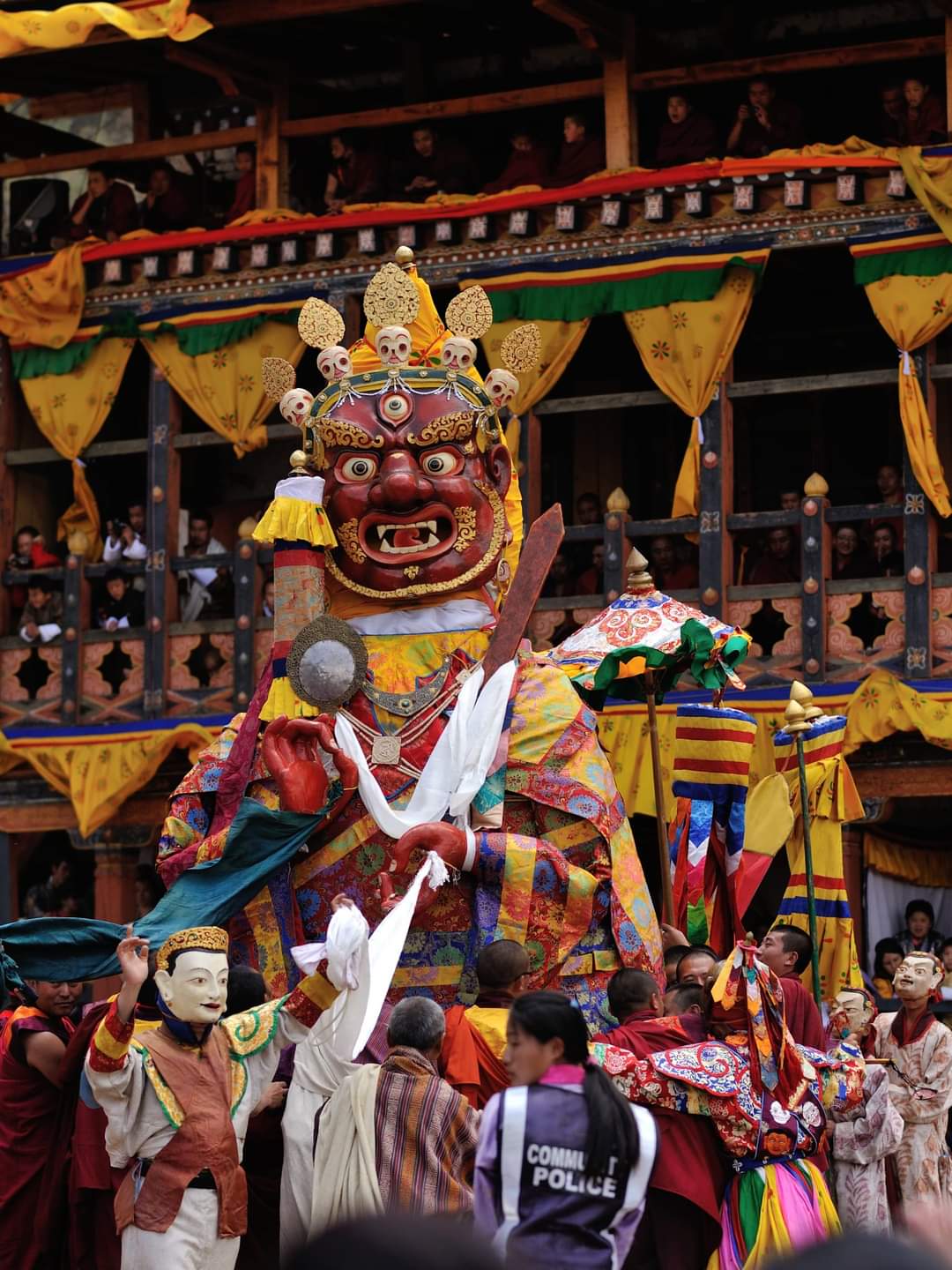
Monks and other performers appear in elaborate masks and richly coloured costumes. The dances convey spiritual teachings through symbolic movement, music and characters. Rather than viewing the performances only as entertainment, it helps to remember that they are religious rituals for many people attending.
Traditional clothing and community life
One of the festival's most beautiful sights is the gathering of families in their finest traditional attire. The occasion offers a chance to appreciate Bhutanese textiles, social customs and the importance of community. Observe respectfully and ask permission before taking close-up photographs of individuals.
A distinctly spiritual atmosphere
Visitors may notice people praying, receiving blessings or watching particular dances with quiet attention. Taking time to understand the meaning behind the rituals can make the experience far more rewarding than simply watching the performances.
How to plan your visit to Thimphu Tshechu
Arrive early and allow enough time
Festival grounds can become crowded. Arriving early gives you more time to find a comfortable viewing position and settle in before performances begin. Exact daily programmes and access arrangements should be reconfirmed closer to the festival.
What to wear
Wear modest, comfortable clothing suitable for a religious gathering. Long trousers or a modest skirt, covered shoulders and comfortable shoes are sensible choices. October mornings and evenings in Thimphu can be cool, so carry an extra layer. Visitors are not required to wear Bhutanese national dress.
Photography etiquette
Festival photography can be rewarding, especially for visitors interested in traditional costumes and sacred dance. Avoid obstructing spectators, respect restricted areas, do not use flash during rituals and ask before photographing people at close range. Follow the directions of organisers and your local guide.
Accommodation and transport
October is a popular time to visit Bhutan. Reserve accommodation and transport well in advance, particularly if your itinerary includes other western Bhutan destinations. A locally arranged itinerary can help coordinate festival attendance with sightseeing and travel logistics.
What is the weather like in Thimphu in October?
October is generally an attractive month for travelling in western Bhutan, with autumn skies, cooler mornings and pleasant conditions for sightseeing. Mountain visibility can be good, although weather is never guaranteed. Pack layers, sun protection and a light rain jacket.
Beyond the spectacle: the spiritual meaning of Thimphu Tshechu
For many visitors, Thimphu Tshechu begins with the colour of brocade costumes, the deep sound of ceremonial horns and the measured rhythm of drums. Yet the festival is not primarily a performance arranged for travellers. It is a Buddhist religious gathering in which prayer, community and sacred dance come together. Understanding this changes how we experience it: instead of looking only for the best photograph, we begin to ask what the dances mean to the people gathered around us.
The festival honours Guru Rinpoche, or Padmasambhava, whose teachings are central to Bhutanese Vajrayana Buddhism. Tshechus traditionally take place around the tenth day of a lunar month, a day associated with Guru Rinpoche. The precise dates vary from year to year because Bhutan follows a lunar calendar for religious observances.
Why do Bhutanese families attend?
For Bhutanese families, attending a tshechu can be an act of devotion as well as a treasured opportunity to gather with relatives and neighbours. Many come to receive blessings, make prayers and witness sacred dances that communicate Buddhist teachings through movement, costume and music. The festival also connects generations: children encounter rituals that their parents and grandparents have known for years.
It is worth remembering that individual experiences vary. Some people attend primarily for religious reasons, others for the shared occasion and many for both. That mixture of devotion and community is part of what makes the atmosphere distinctive.
Understanding the cham dances
The masked dances, known as cham, should not be understood as ordinary theatrical entertainment. Their imagery can convey teachings about compassion, wisdom, impermanence and the consequences of harmful actions. Some dancers represent protective deities or symbolic figures whose fierce appearance is associated with overcoming ignorance and obstacles, rather than celebrating violence.
A visitor may not immediately understand every figure or sequence. That is entirely normal. A local guide can explain the symbolism of particular dances when reliable programme information is available, while also recognising that interpretations can differ between traditions and performances.
What a spiritually curious visitor may notice
One of the most revealing aspects of the festival is often what happens away from the centre of the dance ground. Notice the way spectators respond to particular rituals, how elders sit patiently through long sequences and how families move between moments of laughter and quiet attention. These details offer insight into a tradition that is lived rather than displayed.
Visitors do not need to be Buddhist to find the experience meaningful. For some, the festival prompts reflection on the place of ritual in community life. For others, it raises questions about compassion, mortality or the importance of making time for spiritual practice. There is no single response that everyone should have.
Kado Goes to the Tshechu: Experiencing Bhutan’s Festival Through a Dog’s Eyes
Bhutan’s traditions are passed from one generation to the next not only through ceremonies, but also through stories. Kado Goes to the Tshechu is an animated children’s story written by Bhutanese author Karma Tsering. Karma Tsering is also a co-owner of Bhutan Lhayul Tours and Travels, a family-owned Bhutanese travel company. The story follows Kado, a curious dog, as he experiences the Tshechu. Through his unique perspective, the story offers children and visitors an entertaining way to discover Bhutan’s rich cultural and spiritual heritage.
Watch this animated story before your visit, especially if you are travelling to Bhutan with children. Afterwards, you might discuss what a tshechu means to the people who attend, why traditions are shared across generations and how to approach a sacred celebration with curiosity and respect.
Video: Kado Goes to the Tshechu, written by Karma Tsering.
For visitors seeking a deeper connection with Bhutan, the story complements the living experience of the festival. The animation is an introduction, while attending the Tshechu offers an opportunity to observe its religious and community significance firsthand.
Discover more stories from Bhutan: Families interested in Bhutanese children’s books and stories about local culture and traditions can explore Bhutan Corner, where they can discover more Bhutanese storytelling.
Experiencing Thimphu Tshechu as part of a spiritual journey
Travellers interested in spiritual tourism may wish to build a slower itinerary around the festival. Rather than treating Thimphu Tshechu as a brief stop between attractions, allow time to explore nearby monasteries, understand daily Buddhist practices and reflect on what you have witnessed.
Visit sacred sites with time to appreciate them
In Thimphu, visits to important Buddhist sites can provide context for the festival's imagery and beliefs. In Paro, the pilgrimage to Taktsang Monastery, commonly known as Tiger's Nest, offers a different encounter with Bhutan's sacred landscape. The walk requires preparation and reasonable fitness, but it also invites a gentler pace and an appreciation of the relationship between faith and place.
Make room for quiet reflection
A spiritual itinerary need not involve a formal retreat. It may include a peaceful monastery visit, time to learn about prayer flags and butter-lamp offerings or a conversation with a knowledgeable guide about the role of Buddhism in everyday Bhutanese life. Any meditation session or religious interaction should be arranged respectfully and with the consent of the host community.
Our Bhutan Spiritual Tour offers a starting point for travellers who would like to combine cultural discovery with time at sacred sites. You can also explore our guide to Bhutan's festivals and Paro Tshechu guide to understand how different celebrations fit into a journey.
How to attend with respect
Remember that you are entering a living religious occasion. Follow local instructions about seating, movement and photography. Do not interrupt a ceremony to ask questions or step in front of people offering prayers. Dress modestly and avoid treating sacred objects or dancers as props for photographs.
If you are uncertain whether a ritual is appropriate to photograph, ask your guide before raising your camera. Avoid making assumptions about the meaning of an action based on appearance alone. Curiosity and respect are a better starting point than certainty.
Why local insight matters
At Lhayul, we believe a festival visit is most valuable when travellers understand something of the people and beliefs behind the celebration. Our Bhutanese perspective helps us plan visits that are sensitive to the religious occasion, with enough time to ask questions and experience the festival without rushing. A thoughtfully designed journey can bring together the beauty of the dances, the history of Bhutanese Buddhism and quieter moments of reflection.
We do not promise that a festival will produce a particular spiritual transformation. What we can offer is the opportunity to approach it with context, openness and respect.
Combine Thimphu Tshechu with a Bhutan tour
A festival visit can fit naturally into a wider Bhutan journey. Many travellers combine time in Thimphu with Paro, the hike to Taktsang (Tiger's Nest) Monastery, Dochula Pass and the beautiful valley of Punakha. A thoughtfully paced itinerary allows time to experience the festival without rushing between destinations.
Explore our Bhutan tours for ideas, or learn more about the Bhutan Sustainable Development Fee when planning your travel budget.
Why experience Thimphu Tshechu with a Bhutanese guide?
Much of the festival's significance is not immediately obvious to first-time visitors. A knowledgeable Bhutanese guide can explain the stories behind the dances, help you understand local etiquette and place what you see in its cultural and spiritual context. At Lhayul, we aim to create journeys that feel personal, unhurried and connected to the places and people you encounter.
Frequently asked questions
When is Thimphu Tshechu in 2027?
The published tentative dates are 10–12 October 2027. Please reconfirm the final dates before making non-refundable travel arrangements.
Where is Thimphu Tshechu held?
The main festival performances are held at Tendrel Thang, beside Tashichho Dzong in Thimphu.
Can international tourists attend?
Yes. International visitors can attend, subject to the festival's current access arrangements and applicable Bhutan entry requirements.
Do visitors need to wear Bhutanese traditional dress?
No. Modest and respectful clothing is appropriate. Comfortable shoes and layers are recommended.
Is there a Bhutanese story children can watch before attending?
Yes. Kado Goes to the Tshechu is an animated children’s story written by Karma Tsering that follows Kado, a dog, as he experiences the festival. You can watch it above as a family-friendly introduction to Bhutanese festival traditions.
How many days should I spend at the festival?
Even one day offers a meaningful introduction, but attending more than one day allows time to experience different performances and the festival atmosphere at a relaxed pace.
Experience Thimphu Tshechu with Lhayul
Planning a Bhutan trip around the 2027 festival? We can help design a private itinerary that combines the celebrations with Bhutan's monasteries, landscapes and cultural experiences. Tell us your preferred travel dates and interests, and we will help you plan.