Mindfulness Through Music: Plum Village Songs and Praising the Buddha
Mindfulness does not always require sitting silently in meditation. Sometimes a simple song, a familiar melody or the sound of a violin can bring our attention back to the present moment. During a gathering with visiting Plum Village sisters in Bhutan, music offered another way to experience the teachings.
When we sing words about breathing, presence and peace, the melody helps us remember them. Later, those same words may return to mind while we walk, work, wait or face a difficult moment.
At the gathering on 28 October 2026, participants received a sheet of mindfulness practice songs and the music for Praising the Buddha. At the end of the event, one of the sisters played Praising the Buddha on the violin. The music and printed songs complemented the spoken teachings, showing how mindfulness can be practised in ordinary moments.
Watch: Praising the Buddha, performed on violin
1. Why singing can be a mindfulness practice
We often associate meditation with stillness and silence. In the Plum Village tradition, however, mindfulness is also woven into daily activities. Singing can be one such practice. When we sing slowly and pay attention to the meaning of the words, music becomes a reminder to breathe, to notice how we feel and to return to what is happening now.
Melodies can make short phrases easier to recall than spoken instructions. A song learnt during a gathering can become a quiet reminder later in the day, particularly when the mind is distracted or the pace of life feels rushed. The intention is not to sing perfectly. It is to use the words and rhythm as gentle reminders of awareness.
2. Five Plum Village mindfulness songs
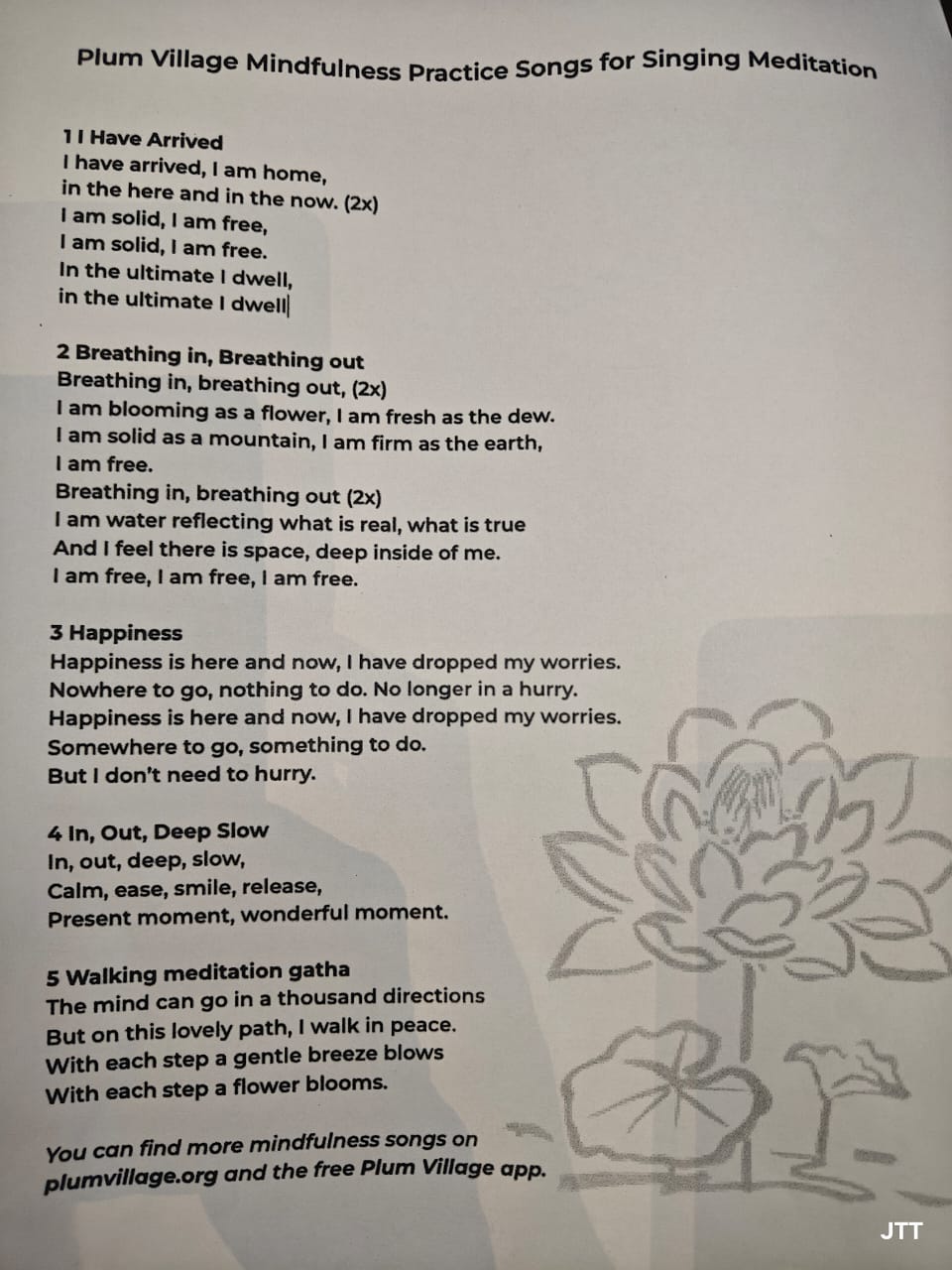
The handout shared during the gathering was titled Plum Village Mindfulness Practice Songs for Singing Meditation. It included five short songs, each pointing to a different aspect of practice:
- I Have Arrived. A reminder of arriving in the present moment rather than always rushing towards what comes next. Its theme is being at home in the here and now.
- Breathing In, Breathing Out. The breath becomes an anchor. Images of a flower, mountain, water and open space suggest freshness, stability, clarity and freedom.
- Happiness. An invitation to recognise that peace and happiness can be experienced now, rather than only after we finish our tasks or achieve another goal.
- In, Out, Deep, Slow. A brief sequence of breathing and relaxation cues that is easy to remember and use during an ordinary day.
- Walking Meditation Gatha. A reflection on walking peacefully, with attention returning to each step instead of following the many directions of a busy mind.
These songs have different themes, but they share a practical purpose: to help people remember mindfulness without needing a long explanation every time they practise.
3. Praising the Buddha: music as an expression of aspiration
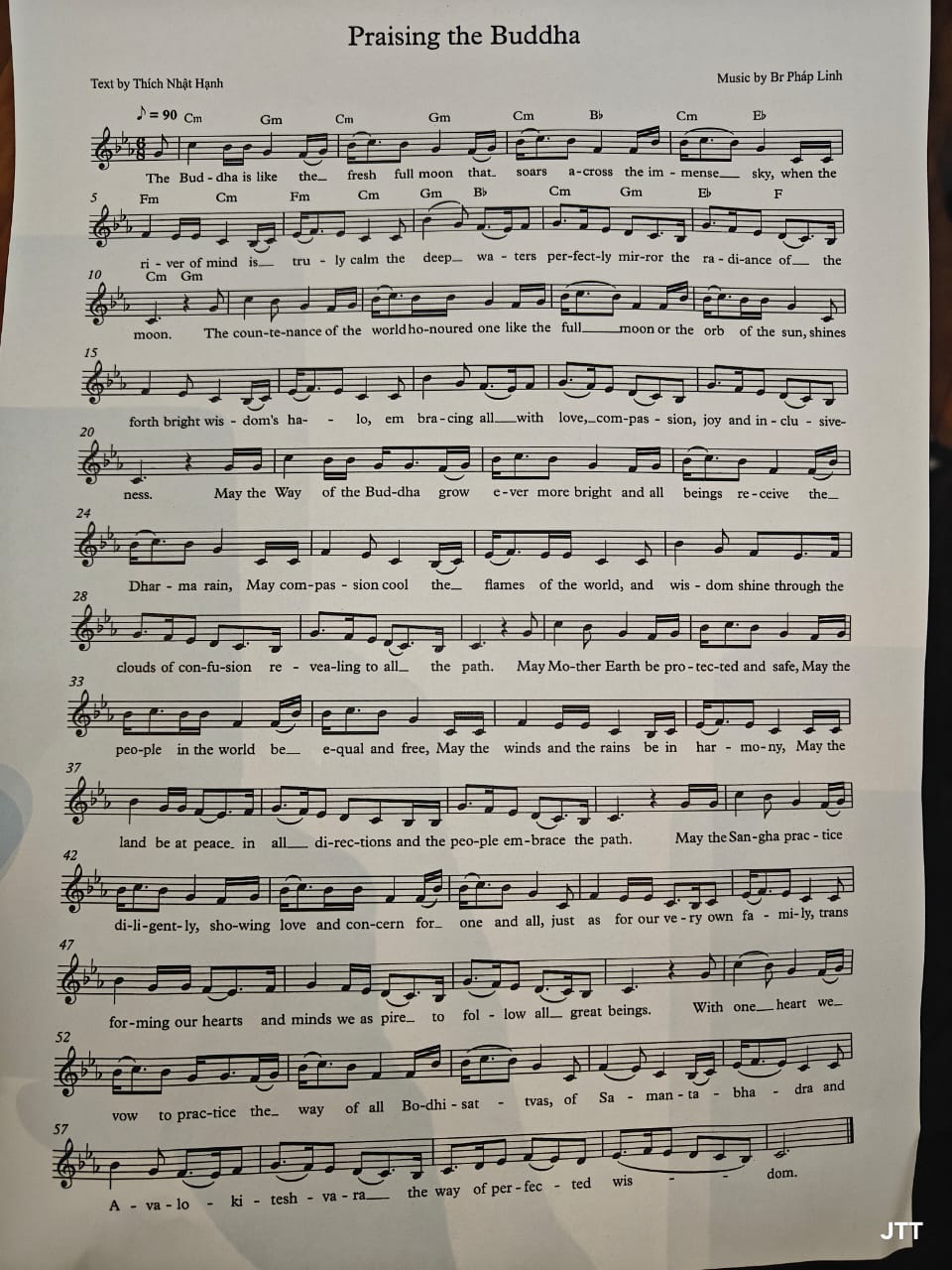
Praising the Buddha has a different character from the short practice songs. The music sheet identifies the text as written by Zen Master Thích Nhất Hạnh and the music as composed by Brother Pháp Linh. Its verses use images of clarity, compassion and wisdom, along with aspirations for peace, harmony and the wellbeing of all beings.
Played on the violin, the melody offers an opportunity to listen attentively even without singing. We can notice the rise and fall of the notes, the spaces between them and our own responses to the music. In that way, listening itself can become an exercise in presence.
The violin performance at the end of the Bhutan gathering provided a gentle transition from listening to Buddhist teachings to experiencing mindfulness through sound.
4. How to bring mindful singing into everyday life
You do not need a musical instrument or a special setting to use music as a reminder of mindfulness. The practice can be simple and personal.
- Choose one short song. Begin with a song about breathing or returning to the present moment rather than trying to remember all five.
- Understand its meaning. Reflect on the words before singing. Notice which idea is most useful to you.
- Sing without rushing. Let the pace of the song encourage steady breathing and attention.
- Recall it during daily activities. A familiar line or melody may help when walking, resting or taking a short break from work.
- Listen together. Singing or listening with family and friends can create a moment of shared attention without pressure to perform.
A small practice: The next time you feel distracted, pause and recall a mindfulness song you know. Notice your breathing and let your attention return to the moment before continuing with your day.
5. A reflection from the Plum Village visit to Bhutan
The sisters' talks in Bhutan explored mindful eating, managing irritation and anger, and the importance of love and understanding in family life. The songs and violin performance added another dimension to those teachings. They showed how a simple melody can help turn an idea into something we remember and practise.
For those interested in Buddhist spirituality and mindful living in Bhutan, the gathering offers a reminder that meaningful practice can take many forms. Meditation may be quiet and still, but it may also be expressed through walking, breathing, singing and listening.
The central lesson is accessible even to someone encountering these songs for the first time: mindfulness is not only something to learn about. It is something we can return to, gently and repeatedly, throughout ordinary life.